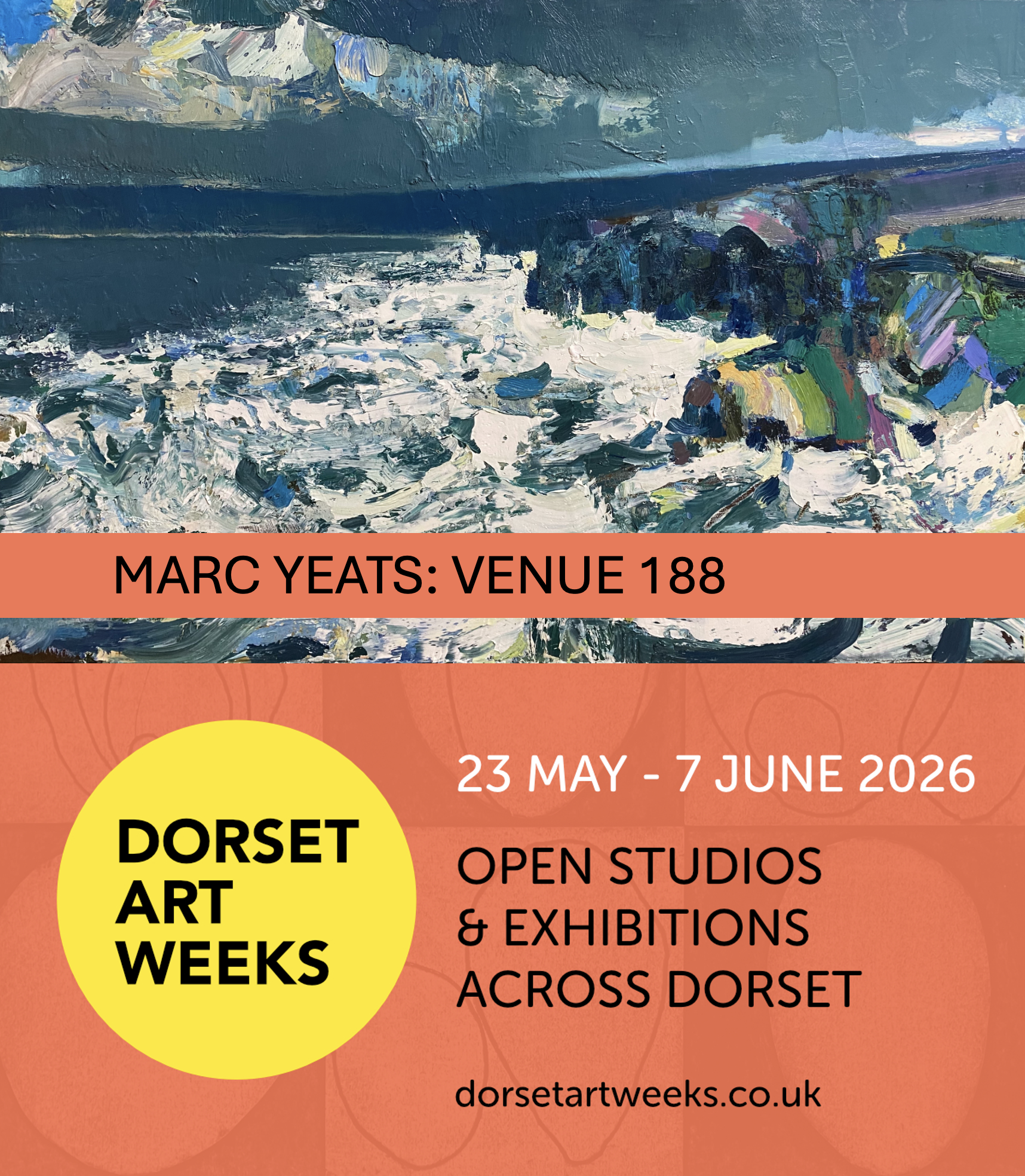
 I am open Tuesday to Saturday (closed Sunday and Monday), 10.30am till 4 pm for Dorset Art Weeks between the 23rd of May and the 7th of June.
At all other times, please make an appointment using the contact page.
You can find me at Unit 39 Electricbackroom STUDIO, Symondsbury Estate Business Park, Bridport • Dorset DT6 6EY • UK.
Click here for Directions. Alternatively, here is a what3words to help you find me: https://w3w.co/inflation.pots.camper
Exhibition Overview:
- Open Studio, Dorset Art Weeks May/June 2026
- The Jerram Gallery (Panter and Hall), Sherbourne 2026 consignment.
- The Corn Exchange Galley, Dorset, Interfaces: Sea, Sky and Land (solo exhibition) (February 10th-March 21st. 2026).
- The John Davies Gallery, Gloucestershire, Essence of Place (2025).
- Fine Foundation Gallery, Durlston Country Park, In Our Nature (joint exhibition) (2025).
- The John Davies Gallery, Gloucestershire, Summer Exhibition (2024).
- The John Davies Gallery, Gloucestershire, Contemporary Modernists (2024).
- The Jerram Gallery (Panter and Hall), Sherbourne 2024-2025 consignment.
- Resipole Studio, Scottish Highlands - joint exhibition (2021).
- Alsop Gallery, Bridport - Solo exhibition and installation sound as I see it (2009).
- An Tuireann Arts Center, Skye - Solo exhibition and installation stillness in movement (2004).
- An Tobar Art Center, Isle of Mull - the Five Islands project (2002).
- Bonhoga Gallery, Shetland - the Five Islands project (2002).
- An Lanntair Arts Centre, Isle of Lewis - the Five Islands project (2002).
- The Pier Arts Center, Orkney - the Five Islands Project (2002).
- The Pier Arts Center, Orkney - Joint exhibition - resound (1997).


Marc Yeats is both a painter and a composer, deeply interconnected in these fields. His compositions influence new approaches to painting, just as his painting techniques inspire his musical creations. A self-taught artist in both disciplines, Yeats explores the representation of surfaces in sound, colour, form, and texture. His work draws from a fascination with geological processes like layering and erosion, and he is captivated by landscapes and the resonances unique to specific places. This ongoing investigation into how these elements manifest across his creative mediums has become a lifelong passion and challenge for Yeats.
While no one artist heavily influenced him, Yeats admires a wide range of practitioners, from Van Gogh, Turner, Constable, and Eardley to Pollock, Richter, and Bacon. He works primarily in oils, acrylics, and mixed media on paper and board. Based in Somerset, England with a studio in West Dorset, Yeats finds inspiration in the land and seascapes of his surroundings and travels within the U.K.
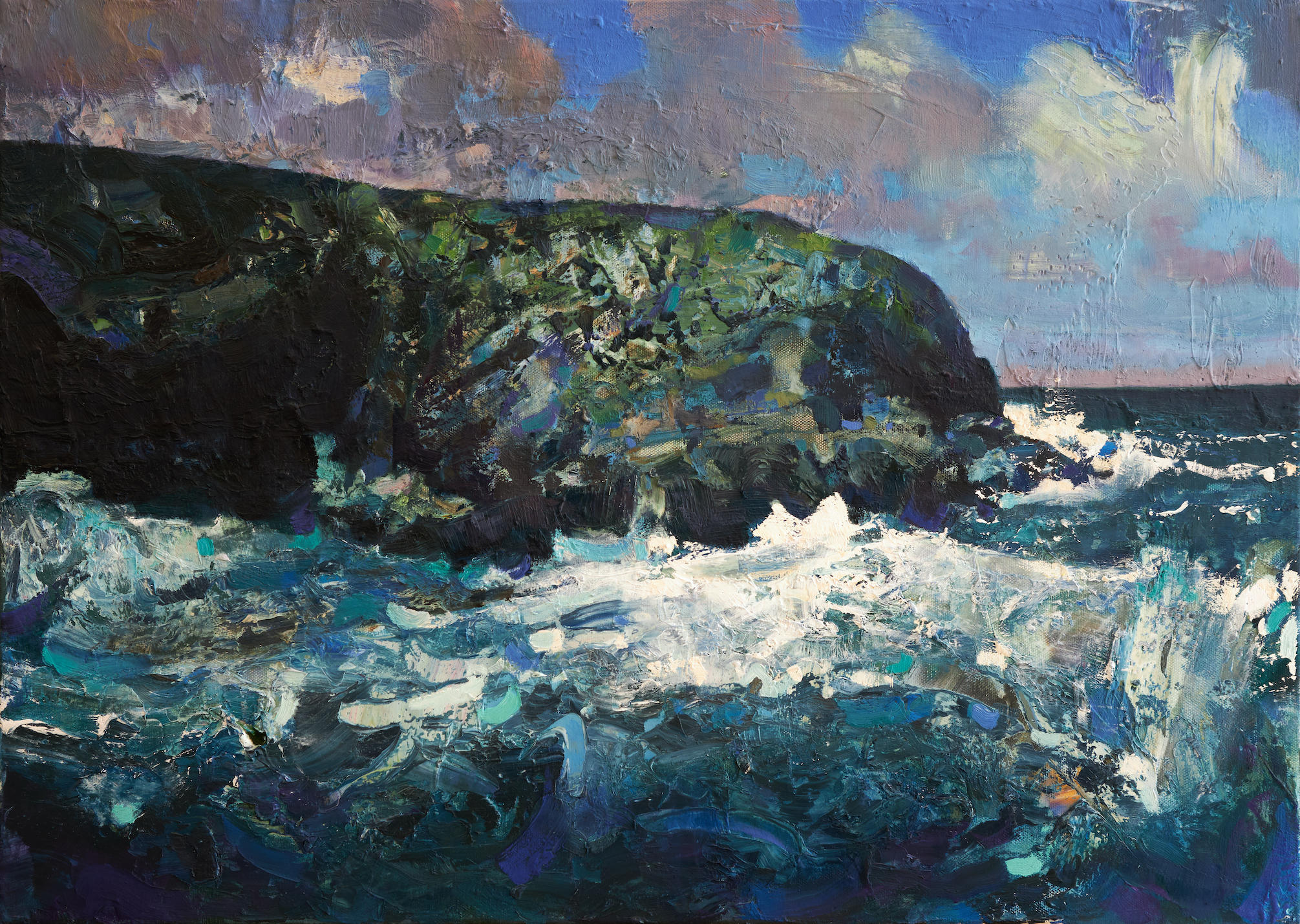
Although drawn to abstraction, Yeats gravitates towards land and seascapes to express the interplay of light, shadow, sky, land, and weather. However, he does not aim to mimic nature or create an illusion of reality, a pursuit he abandoned in his twenties. Yeats neither paints from life nor photographs. Instead, he sketches and spends extensive time in the locations that inspire him. His work is not about translating these experiences into direct depictions but capturing the impressions and memories of the places he loves. For Yeats, a location’s essence—structures, changing dynamics, and atmosphere—emerges more vividly when processed through memory and perception over time. This process is expressed through bold, colourful, gestural mark-making characterising his painting.
Yeats does not begin with a specific subject in mind. Instead, his work emerges through the physical act of painting, often beginning with spontaneous gestures using oil or acrylic paints, as well as crayons, markers, and pencils. Despite this spontaneity, the familiarity he has developed through years of experience likely means these actions, while appearing freeform, are highly practised responses to his environment. To counterbalance this familiarity, Yeats often introduces kinetic force or movement elements into his painting process, sometimes even closing his eyes to relinquish control over the outcome. Layer upon layer is added until something recognisable—a light effect, a landscape form, or a familiar atmosphere—begins to take shape. At this point, he focuses on developing the image, refining it until it resonates with his memories or sensations of the real world.
My titles use words to interpret a mood, memory, observation, evocation, place, idea, ideal, or impression signified through paint. They are playful, poetic prompts or geographical locations—starting points, not destinations—and are not meant to be taken literally. A painting's meaning is not confined by its title; it is elastic, shaped by each viewer’s perception. These paintings are not depictions of experiences or things; they are the experience. They are the thing itself.
What makes Yeats's paintings distinctive?
Yeats’s paintings are shaped by an interest in how things relate, shift, and hold together, even as they bend, stretch, or change. While this approach has roots in mathematics—particularly in topology, which understands form through relationships rather than fixed shapes, focusing on how elements connect, flow, and transform while retaining continuity—his way of working is not rigid or formula-driven. It is guided by the moment: by the feel of the paint and by what begins to unfold as the work develops. Some decisions arise instinctively, others through deliberate control, but all are grounded in a physical, sensory engagement with the act of painting. This is what gives the work its sense of life.
At the heart of his practice is what he describes as polyphonic abstraction. Borrowing from music, where different voices sound together, he builds paintings from multiple layers and perspectives that coexist within a single space. Through this, he creates a shifting interplay of light, colour, form, texture, and atmosphere—echoing the changing landscapes and seascapes of the British Isles.
This way of thinking also shapes his mark-making. He uses bold, often spontaneous gestures that transform elements such as coastlines, hills, cliffs, and valleys into forms that are only partly recognisable. What matters is not precise depiction, but the relationships between things: a cliff edge opening into sky, a valley folding into a hill, or colour moving from sea to land. A curved horizon might suggest height or enclosure; a drifting shape might carry a sense of movement or emotional weight. These forms are not carefully mapped out—they emerge through a direct, physical response to the surface, with each mark suggesting the next.
Visually, the space in his paintings is often fluid and unsettled. He sometimes uses movement or even paints with his eyes closed to break down conventional depth, allowing foreground, sky, land, and water to merge or overlap. This creates an open, experiential space in which the viewer can find their own way through the image. The titles act as gentle prompts—poetic points of entry that leave room for different readings.
Although the imagery is somewhat abstracted, the work remains closely tied to how he sees and, more importantly, experiences the world around him. He is interested in capturing passing impressions of light, weather, and geology—moments that are absorbed and then reshaped through painting. By working with shifting relationships rather than fixed forms, he retains a sense of land and sea while allowing it to remain in flux. These paintings are not representations so much as painted, remembered encounters. They emerge through a particular way of seeing, but are ultimately guided by the body, by intuition, and by the unpredictable nature of the process itself.
Alongside his painting, Yeats is also a composer. His music has been performed by ensembles including the BBC Scottish Symphony Orchestra, the BBC Philharmonic Orchestra, and the Hallé Orchestra, and broadcast on BBC Radio 3.
He is also a published writer. Books from Vision Edition explore his work in both painting and composition, and his most recent project is a collection of over 230 poems reflecting on his life as an artist.
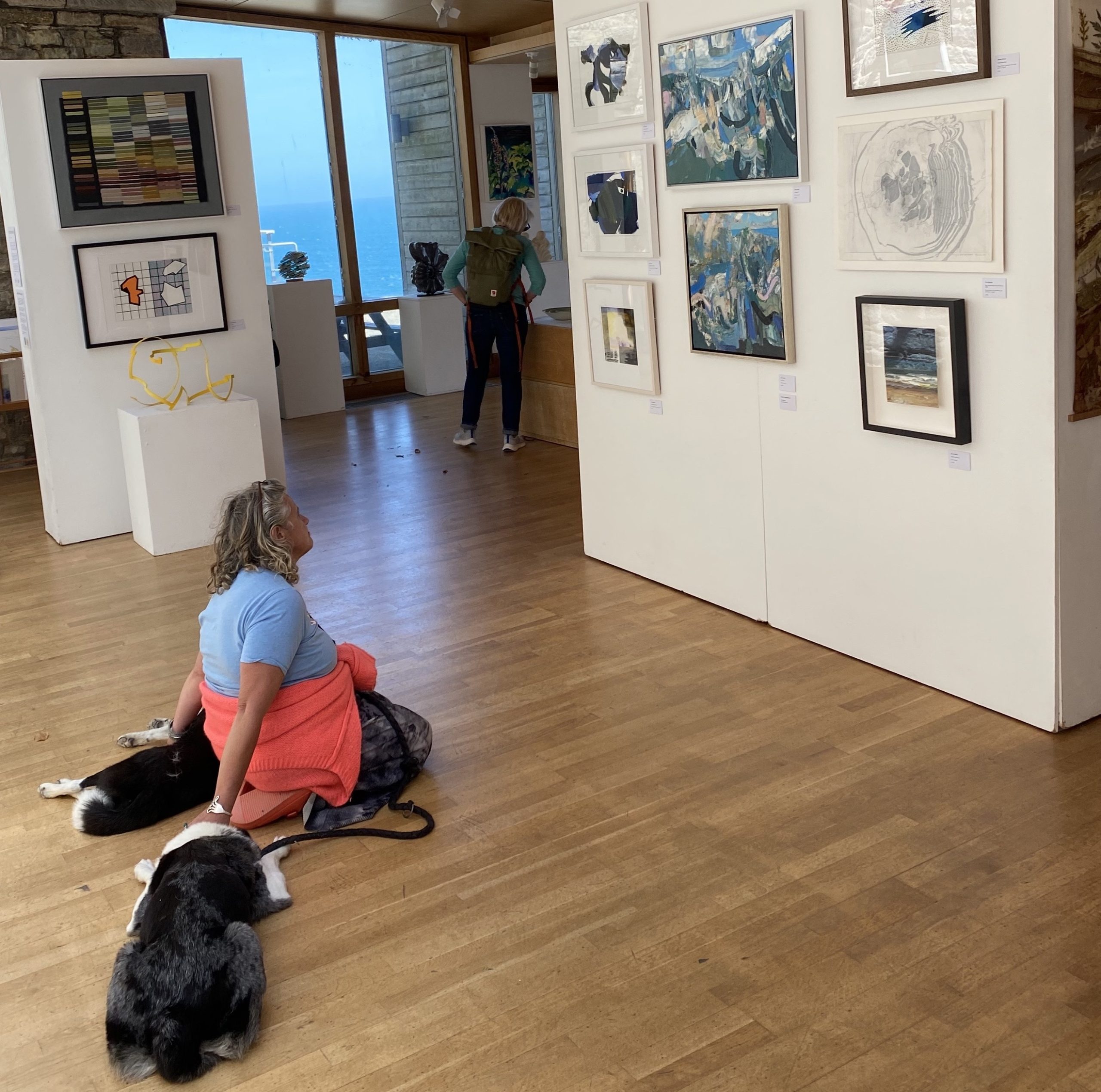
Yeats's works are available for sale online from this site and can be viewed in person at his studio in Symondsbury, Dorset, as well as a number of galleries around the British Isles. He is represented by the John Davies Gallery, Morton-in Marsh, Gloucestershire,
Music, Painting, Landscape and Me
Vision Edition
Vision Edition are thrilled to announce the publication of ‘Music, Painting, Landscape, and Me’ by Marc Yeats, released on the 1st April 2024. In this book, Marc Yeats embarks on an introspective journey, weaving together the symbolic realms of music and painting through the written word. This endeavour expands upon the immediacy of engagement with his compositions and paintings and what these artworks tell us, offering further understanding and dialogue concerning their interrelation. Yeats’s transformation of his inquiries and insights into text emerges from a conviction that the foundational questions—the ‘whys’ and ‘hows’ of being an artist and his creative exploration—resonate far beyond the confines of his personal experience, reaching out to a wider community of artists and those intrigued by the mechanisms of artistic expression.
For more information and to order this book, please click here.
