music, landscape and me [3]

music, landscape and me

. . . on the third day
May 4 2012

There was more Vaughan Williams.

Gedney_Drove_End_Lincolnshire_pencil_imperial
Gedney Drove End, Lincolnshire: pencil on paper (imperial size) circa.1989

In fact, the music of Vaughan Williams has played a central part in my own musical life. Apart from the rather glib, ‘I like it’, there are aspects of his music that work on many different levels for me, most deeply personal.

It’s easy to assume that as a composer, one emulates the music of others that is especially admired or liked. It is true that in some of my initial efforts of throwing notes together I was strongly influenced by Vaughan Williams and the English Pastoral School. But I was also aware that this had been done and done brilliantly many years before so what could I possibly have to add by creating more ‘sub-Vaughan Williams’ music: Nothing! I was also aware that copying was not for me; even being strongly influenced by the work of others made me feel uncomfortable.

Near_Fring_Norfolk_pencil_imperial
Near Fring, Norfolk: pencil on paper (imperial size) circa.1989

At this point in time (late 1980s) I had no idea where I would end up musically, only that I was being driven forwards by a deep emotional need to write music; my ‘own’ music, that was unlike the music of others.

Emotionally, the sound-world of visionary pastoral music was my homeland. It had been for some time, especially through the very turbulent times leading up to and following the death of my mother in 1977. Although hard to quantify, I believe that the music I was listening to at the time kept my inner world alive. I had begun painting and knew that my life would never be the same again, but I was also being obsessed by sound and similarly knew that this ‘burden’ as it was then, would be central to my development. I would become a composer. These things were certain.

So Vaughan Williams (and others) offered me hope, light and sustenance to keep going through the gloom, misery and insecurity of much of my teenage years. This hunger for ‘soul-food’ was also reflected in my relationship with the land or to be more precise, with particular landscape and places. It’s clear I have a great connection to pastoral music and landscape but at the same time, would not compromise and emulate this music in my own work. So what was I trying to achieve through my own music and painting and now photography?

40746906-IMG_0561
Near West Chinnock, Somerset, 2012

This is such a difficult question to answer and I don’t know if I have sufficient command of my inner world to be able to give a definitive statement. What I can say and will no doubt repeat several times across these articles is that the quality of feeling I experience when listening to the music of some other composers coupled with particular landscapes is a keen driving force behind the kind of music and images I want to create. Whether misguided or not, I want to, in some inadequate way, communicate these feelings; recreate them – the wonderfulness, grandeur, warmth, value, desolation, ugliness, beauty, other-worldliness, transcendence, almost spiritual (as opposed to religious) sense of apotheosis particular landscapes as well as music of others engender in me, and re-create these experiences through my own work.

Spring_Norfolk_pencil_imperial
Spring – Norfolk Fields: pencil on paper (imperial size) circa.1989

Lofty ideals and I’m not sure if I achieve any of them for I cannot tell what other people feel and think when they experience my work; I can only appreciate the feelings my work initiate in me, and that’s no guide, no guide at all for what others will experience! So, blindly (and perhaps deafly), I continue down this road. It’s the only road I know!

I’ve previously mentioned my love of chalk and shall write more extensively about that later. But for now, I’d like to focus on a time I spent exploring Norfolk in the late 1980s and how this land effected my work, acting as a vehicle to enable me to express through image some of the feelings I have described above.

40747012-IMG_0428
Beaminster Down, Dorset 2012

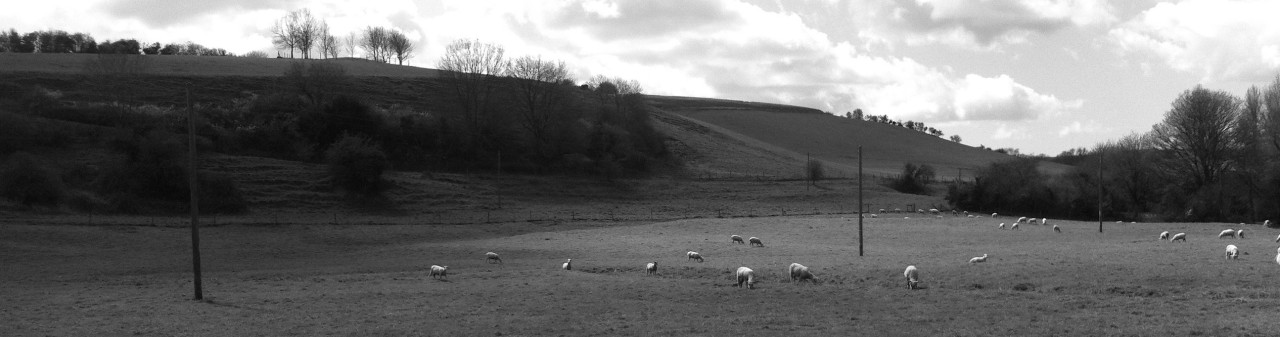
Horizons and light – big skies – that’s Norfolk in a nutshell! Towards the horizon’s endure. The land goes on and on – the horizon never ends; the skies are so large and heavy they press down on you, sometimes claustrophobically. The land is haunted with echoes of the past. Quiet, changing little, this land has a specific sound, feel and ambience; a very particular look that I can recognise instantly. Norfolk isn’t always a ‘pretty’ or twee place. Certainly around the coastal fringes, vast salt marshes and mud flats it can feel like the most isolated and lonely place on earth. And in bad weather; like the end of the world. It is a very particular place where ‘beauty’ is often found in its loneliest spots away from the picture-postcard tourist dives. This is where you’ll find the beating heart – where you’ll ‘hear’ the music.

40746822-IMG_0558
Near West Chinnock, Somerset, 2012

40747052-IMG_0813
Near Crewkerne, Somerset, 2012

North_Walsham_Norfolk_pencil_imperial
North Walsham, Norfolk: pencil on paper (imperial size) circa.1989

As ‘horizon’ is so central to these landscapes and so central to my own visual work (and in a bizarre sense, my music, too), I’m concentrating this article around photographs and drawings that exemplify my feeling of horizon. Not all the work is from Norfolk, but I hope it will be clear to see the common aesthetic thread that runs through my visual work, wherever its landscape is rooted.

Near_Somerton_Norfolk_pencil_imperial
Near Somerton, Norfolk: pencil on paper (imperial size) circa.1989

And to round off, the very poignant, impressionistic tone poem ‘Norfolk Rhapsody No. 1’ by Ralph Vaughan Williams

music, landscape and me [2]

music, landscape and me

. . . . and then there was ice!
May 2 2012,

40658171-Burton_Mere_looking_west-1
Burton Mere, Dorset (2012)

40658294-Ditch_Burton_Mere-1
Burton Mere, Dorset (2012)

The winter of 1985 was a hard one.

Frozen.

For some reason I had decided to travel to west Dorset in the middle of winter to visit a place I’d never been to, Burton Mere near Cogden Beach, on the whim that I thought it may be an inspirational place to go.

I’ve been doing this for some time; packing off on a jaunt to a place that ‘calls’ me without any hard facts that it will prove to be the place I want to be at all.

The story (yes, I’m afraid there is a short one) goes back to a black and white poster I acquired from British Coal back in the ‘70s. Among other coal related photographs, the wall poster had a section of cliff displaying many layers of stratification. The poster was on the back of my bedroom door and bewitched me from the moment I put it up. I examined its every detail, from the shore to the cliffs, feeling my way around the rugged contours with my imagination. Originally, my interest in obtaining the poster was the fossils to be found in coal but this section of coastline, incidentally illustrated on the poster (for geological reasons I didn’t know at the time) stimulated my imagination and emotions in ways hitherto unknown to me.

Unfortunately there was no indication of where the location was. I committed the picture to memory – its feel and contours – for future reference.

Some time later whilst looking through reference books in the British Geological Museum Library (for which I obtained special permission, being a minor), I randomly happened upon a photograph of the same cliffs. I knew immediately this was the place; every fibre and sense in my body resonated with delight. What’s more, the book told me exactly where it was; Church Cliffs, Lyme Regis, Dorset. Henceforth my love affair with the county began. I shall make reference to this place in future articles. I was 13 at the time.

This brings me back to why I was visiting Burton Mere in the winter of 1985. I was drawn to explore because I had ‘felt’ the place from afar and knew it held something I wanted; something that the landscape there could offer.

I was a fledgling composer – full of music in my head and totally unable to write any of it down, as I knew nothing about music at all, just that it was running through my veins uncontrollably. But by this time, at the tender age of 22, I was quite the developed landscape painter. So I was there, Burton Mere, in the ice, to find subjects to take away and paint. Consequently, I produced two paintings from that trip (as below).

Burton_Mere-1
Burton Mere, Dorset: oil on canvas 30×16″ 1985

Ditch_Burton_Mere-1
Ditch, Burton Mere, Dorset: oil on canvas 30×16″ 1985

There’s more:

I was alone on this expedition. For company I took my brand new Sharp cassette player with headphones (remember those)? Among the tapes I took with me was Tippett’s 2nd. Symphony; a wonderful work full of passion and colour and at times, ecstatic writing like only Tippett can produce (for me, he is the musical English Ecstatic). However, due to the conditions and where I was walking at the time, one movement of this work, the 2nd., slow movement, adagio molto e tranquillo, resonated with the landscape and conditions. The impressions it left have stayed with me, unchanged all these years.

40658317-Burton_Mere-1
Burton Mere, Dorset (2012)

Beauty in austerity

The ice cold of that day was echoed in this music; the metallic, brittle sound of trumpets and percussion created the ‘coldest’ music I had ever heard whilst the occasional interludes of luminous, swaying strings brought a warmth that was much needed. Yet this music was neither ‘nice’ nor soothing nor necessarily inspired by the landscape, but within it’s rugged austerity there was a beauty I recognised and loved. Like Burton Mere, a desolate location, especially in the middle of winter, yet yielding a dignified rawness that spoke of the essence of the place with no frills, no ceremony or affectation. This was ‘real’ music resonating with a ‘real’ place in my body and mind. Somehow, the music and the land together catalysed an alchemy that sent my spirits soaring with a sense of being alive, in the present and connected to something greater than myself; such is the power of music and the land. When I hear the music now, I’m right back there in the blink of an eye; my memories triggered through the senses by the potency of this music.

40658344-Cogden_Beach_looking_west-1
Cogden Beach by Burton Mere, Dorset (2012)

27 years later, I visited the Mere again and took a number of black and white photos; these are presented at the top and throughout this article. This time there was no ice, the reeds had been allowed to grow back naturally and cover much of the water; the water levels were much lower and the place full of the sights and smells of the cusp of seasons as winter erupts into spring. What hasn’t changed is the sense of isolation, openness and glorious desolation.

Sir Michael Tippett Symphony no.2 – 2nd. movement: adagio molto e tranquillo

music, landscape and me [1]

music, landscape and me

in the beginning
May 1 2012

I am starting this blog in response to a request and suggestion from my great friend and artist, the fine art photographer, Ian Talbot who recently embarked on an exploration of his images and their relationship to the music of others here.

40648044-IMG_0751-1
Bincombe, Crewkerne, Somerset

Where to begin?

It’s difficult to unpack quite how I got where I am now, in my head, musically.

I don’t expect these articles to be a logical or sequential path through the ruminations of my mind and history; rather, a dip-in and dip-out of remembrances, feelings and perhaps conclusions that I have drawn about the relationship between the visual – my paintings and most recently, my landscape photography (as seen here), and my ever driving need to write music.

I have no doubt these links exist within me: My pulse quickens when I see configurations in the landscape that stimulate and this stimulation in turn evokes sounds in my mind. ‘Sounds’ as opposed to music – that comes later – but these sounds are somehow related to and driven by both the physicality of the landscape and the ambience of it. But not all landscapes have this effect.

Beauty is not enough.

In fact, beauty in the conventional sense of landscape quality has nothing to do with it. What drives my sense of excitement about a landscape is the geology that underpins it. For me, the noble Chalk is king, but in general, landscapes formed from sedimentary rocks capture my imagination. I love the Mesozoic geological period for the strata it owns and the landscapes, especially in southern England it engenders.

40648086-IMG_0652-1
Wynford Eagle, Dorset

It is now my life’s work to explore these landscapes and be inspired by them, this, not in any bucolic or nostalgic sense, nor even a romantic one (though these claims are perhaps a little too self-certain). In fact, I’m quite unsure how to define this drive and these responses. Certainly, my music best articulates how the visual (landscape) transforms into sound (music), within my work with the results being perhaps unexpected considering the source of inspiration, but who’s to say that our perception of what a pastoral landscape is evokes only a pastoral style music as valid response?

Having said that, my first profound music and listening experience is with English Pastoral Music and I have to this day, remained deeply in love and affected by the genre.

So, this is where I shall start.

Vaughan Williams’ Tallis Fantasia

I first encountered this piece when I was about 14. I was living in London. I had just started to paint – representational landscapes – this was the beginning time. I knew, even then that I wanted to compose but had no real idea what this was or what it involved, I just knew that my head was full of sounds and these sounds made me feel differently to usual.

My mother was dying from cancer. She loved to listen to music. Both my parents listened to Led Zeppelin, Emerson, Lake and Palmer and Focus – typical rock bands from the 70s.

I don’t know who bought it, but one day, my mother started to play an LP of Vaughan Williams’ string music, conducted by Sir Adrian Boult. Her favourite piece (I know this due to the repeated playing) was the Tallis Fantasia. The music would make her cry. I resented this. She was so ill and the sound of her crying was too much for me. Consequently I tried to stop her from listening to the music. I remember even hiding the LP for a time. This didn’t succeed for long.

Remarkably, as the weeks passed I began to despise the music less. Moreover, I was being increasingly drawn to listen, privately and away from my mother. I subsequently realised I had not only ‘despised’ this music because it made my mother cry, but because it challenged me, it made me want to let go of my emotions of grief and anger too; a threatening prospect as I was desperate to maintain a modicum of control. I became increasingly obsessed. Even more strangely, when listening to the music I was transported away to another place within myself. This place was full of landscape – landscapes a city boy like me hadn’t even seen yet – full of light and air and magnificence. It quickened my pulse and touched something tender inside that made me – drove me to want to paint and especially write music. I wanted to recreate the effect on others that Vaughan Williams had on me. At 14 years old, that is what I knew and it is that which pushed me forwards to become a composer and painter.

The music still has that same power over me now. What a masterpiece!

Ralph Vaughan Williams Tallis Fantasia

Sturzstrom: for massed choirs [2]

Sturzstrom: for massed choirs

Sturzstrom: now complete!
October 14 2011,

sturzstrom (a landslide event for voices) is now complete.

This has been perhaps the most demanding of pieces for me to write. In trying to obtain the vocal effects and structures I wanted I have had to ‘project’ and contain the various possibilities that the notational methods I have chosen to deliver sturzstrom could encompass. In other words, in my usual scores, every detail is controlled and notated precisely, so I know exactly (more or less) what it is I’m going to get in performance. sturzstrom has been totally different in that there is no definitive performance, but a performance that exists within the parameters set by the coaching and shaping of the music with the performers as part of its being brought into being.

33011580-Screen_shot_2011-10-04_at_14.10.27

To help clarify this process and the expectations of delivery and performance I have written extensive performance notes in the score.

sturzstrom has been composed as ‘a landslide event for voices’ meaning the work attempts to depict landmass movement and geological process as found along the ‘Jurassic Coast’ of East Devon and Dorset. Naturally, this depiction is not a scientific reconstruction of these processes in sound; rather, an imaginative response to these forces and outcomes as contrived in the composer’s imagination and amplified by the individual contributions of the performers. sturzstrom has been designed to utilise the voice rather than singing ability and is conceived and notated in such a way as to enable maximum participation from individuals with little or no experience of singing or reading conventional music notation.

33011611-Screen_shot_2011-10-03_at_10.14.51

Inevitably, this involves some new learning to understand and interpret the signs and symbols used in this score as well as the general concept and approach used by the composer to articulate his ideas. Both the composer and conductor will be responsible for explaining, shaping and guiding the choir’s responses to the notation, graphics and text.

33011989-F1.smallAlong with the massed voices there are three strands of pebble percussion for younger performers; the first two strands deal with a more advanced interprutatrion followed by a thrid strand, a pebble chorus, performed by children of primary school age adding a further layer of mass percussive activity. As in the voice-work, the various strands of the percussion section are designed to be performable by the widest range of young people with interpretation of the various notations being facilitated by the conductor and composer. For authenticity, It is also desirable that each participant in the percussion section has found their own performance instrument (stones and pebbles) from the stretch of coastline featured in this work.
33011631-Screen_shot_2011-10-04_at_14.09.06

sturzstrom is designed for massed choirs and will work best with large numbers of individuals, employing as it does flocking and ‘crowd sourcing’ techniques to initiate complex textures, harmonies and articulations of its material, be they sung or spoken.

33011656-Screen_shot_2011-10-04_at_14.08.31

The structure of the score leads to an intense climax (the landslide event) but along the way, geological text from scientific papers is used to add vocal content to the music; this content is articulated in a variety of ways using non-conventional notation and graphic notation (explained below). The work covers the Mesozoic geological time period and includes the layers of strata found in this time period between Exmouth in East Devon and Lyme Regis in West Dorset. These successions of strata are documented through sound in the piece and culminate in an imaginary journey along the coast, traveling east to west, before the landslide event occurs, setting the scene as it were for the catastrophic landslide (blockslide) that occurred at Bindon on Christmas Eve, 1839.

33011941-Bindon_Plate2Read by the Orator and bookending this scientific data is the wonderful ‘Petition of the Mayor and Burgesses of Lyme Regis, County Dorset, 20 August, 1533’, where the people of ‘King’s Lyme’ express their fears for the town as coastal erosion and landslides threaten its very existance. This letter brings an human perspective and cost to these processes of coastal movement and remind us that the situation described in 1533 has not changed or been remedied in our own day but is at best, temporarily contained.’

33011965-Lyme_Landslide2

The first workshop for sturzstrom took place in Exeter on the 12th of November.

Sturzstrom: for massed choirs [1]

STURZSTROM: what is it?
May 4 2011

A landslide event for voices!

‘Sturzstrom’ is a vocal work that expresses in sound the formation and geology of the Jurassic Coast concentrating on the phenomena of landslips, mudslides and coastal erosion.

The work will be a primordial, timeless piece that reflects Deep Time and geological processes in sound, structure and process of composition, echoing the creation of the land, strata and Jurassic Coast across time. Using the power of massed choirs, it will act on communities, singers and audiences at a visceral, atavistic level, capturing and integrating their reactions to it. Vocal content will be developed and shaped in local communities in East Devon and West Dorset through creative workshops with the composer, using texts relating to the geology of the Jurassic Coast as the basis for non-narrative content. Through the Jurassic Arts Team, the composer and community choirs will also work with geologists and scientists who will inform the creative process, both compositionally and in the origination of the vocal text).

25697153-coastal-voices-image-1a-1-1-1

‘Sturzstrom’ is part of the the Coastal Voices project and will look at how the geology we see along the coast was formed and how it is being shaped today, how that geology has shaped the land above and how the landscape created affects us as people.

25697803-3421886675_2af33c6dec

mudslide

A sturzstrom (German literally for “fall stream” or “collapse stream”; the correct German term, however, is “bergsturz”) is a rare, unique type of landslide consisting of soil and rock which is characterized by having a great horizontal movement when compared to its initial vertical drop – as much as 20 or 30 times the vertical distance. Sturzstroms are similar to glaciers, mudslides, and lava flows. Sturzstroms flow across land fairly easily, and their mobility increases when volume increases. They have been found on other bodies in the solar system, including the moon, Mars, Venus, Io, Callisto, and Phobos. More information can be found here.

mudslide and sediment

A Coastal Voices commission, ‘Sturzstrom’ will be performed in Weymouth and Portland as part of the Cultural Olympiad celebrating the 2012 Olympic Games.

My aims:

To compose an original and experimental piece of new music for community choirs
To create a work which explores a variety of new and innovative vocal and percussive techniques
To bring together singers from a range of choirs, backgrounds and ages
To give community singers the opportunity to sing with massed voices
To take community choirs and singers on a journey from their familiar musical world into the sound world of the composer
To support choirs with creative workshops led by the composer and with mentoring for choir leaders
To enable singers to contribute to the pitch content of the music through guided aleatoric and graphic notation

25782570-images-1

The challenges:

The challenge is twofold –

Firstly, to research with geologists the very sound of landslips and morphodynamic changes in the coastline and translate these sounds and sound processes to the human voice through the structure and content of this new commission as well as finding suitable geological and scientific texts that can be ‘treated’ for performance purposes to form the vocal word content of the piece.

Secondly, to notate the musical content of ‘Sturzstrom’ in such a way as to be totally inclusive of those with no musical experience, be that singing or reading conventional music notation, so that they can learn and perform the piece to the highest standard. This notation will be forged with the individual groups forming a highly personal and communicative language that will be capable of communicating the pitch and rhythmic content of the score as well as shaping sounds in ‘live’ performance (with guidance from the conductor). The music will contain a measure of aleatoric and improvisational material that will be rehearsed and considered to form part of a cohesive whole. These elements will allow for a co-creative relationship between composer and singers. The resultant music will be complex and highly textural with many individual layers of activity moving together to create movement from focus to flux as the landscape of the music forms, erodes, slips, slides and reforms again.

Blackven, near Charmouth, Dorset